- Continuity/Hollywood editing - Viewer should not notice the cuts. This means the shots should flow together naturally making them look continuous. This advert explains continuity.
- Montage - this style has two functions. The highly political soviet style of the 1920's which sought to create a new meaning out of seemingly unconnected shots connotating things to the audience. The audience are very aware of the cuts, this is normally done by Serge Eisenstein.
- Hollywood Montage - in classical Hollywood cinema, a "montage sequence" is a short segment in a film which narrative information is presented in a condensed fashion.
- Transitions - this is the term for how an editor move s from one shot to another, the use of an improper transition can destroy the mood or pace of a scene.
- Crosscutting/Parallel editing - Editing that alternates shots of two or more lines of action occuring in different places, usually simultaneously.
- Dissolve - A transition between two shots during which the first image gradually disappears while the second image gradually appears.
- Wipe - a transition between shots which a line passes across the screen replacing the first shot with the second. Usually used in action or adventure films.
Sunday, 27 September 2009
Editing

Camera Angles
Some of the main camera angles are:
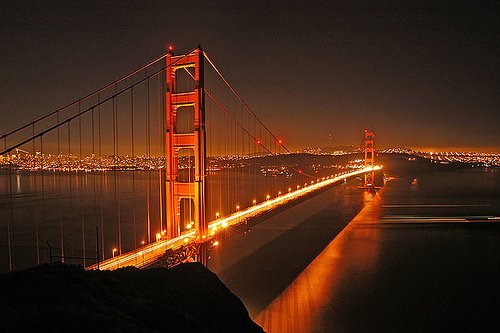
- Long shot - this lets the audience know the setting in which the narrative is set. It shows all the important information. This example shows the audience that the narrative is set at night in san francisco.
- Medium shot - this is used to show when characters are interacting.

- Close up - this is used to emphasize importance to the audience.

- Shot reverse shot - this is used for dialogue. you focus on the speaker with the camera positioned on the other persons shoulder. This makes the audience feel like they're part of the conversation.
- High angle - this is when the camera is up high pointing down. This connotates that you have power over the object or person you're viewing. Traditionally women are filmed like this to make men seem more powerful.

- Low angle - this is the opposite to the high angle it's used to make an object or person seem more powerful. Men are usually show in this angle.

- Tracking shot - this is when the camera is parallel to the action and follows it on a track.
- Tilt - the camera goes up and down, normally done from women's feet to the woman's face.
- Pan - this is when the camera swivels over 180 degrees.
Saturday, 26 September 2009
Mise en Scene
Mise en Scene is a french term for the analysis of everything you see on screen, this doesn't include sound. The 5 categories of Mise en Scene are:
- Lighting - why is the scene lighted the way it is? what does it symbolise? what does it tell you about the situation? what does it connotate/denotate?
- Setting - what does the setting say about the situation/character/action?
- Characters, acting and facial expressions - what do these show about the situations? what does it tell you about the charaters personality/feelings?
- Props and costume - what does this tell you about what's happening?
- Camera Angles - how do they make the audience feel? what does is show about the characters?
Narrative Theory - Vladimir Propp
Vladimir Propp was a Russian critic and literary theorist who analysed over 100 Russian folk takes in the 1920's. He proposed that it was possible to classify different characters into clearly defined roles and the functions they do.
Propp's character roles:
- The Hero (who always aims to seek something)
- The Villain (who opposes the hero and tries to stop him)
- The Donor (who gives something to help the hero along his way)
- The Dispatcher (who sends the hero on his journey to seek in the first place)
- The False Hero (who pretends to be the hero)
- The Helper (who provides support to the hero)
- The Princess (the reward for the hero, normally a woman who needs protection)
- The Princess' Father (who gives the princess as a reward)
Today, not as many films, programmes or stories fit this, an example is pulp fiction where-as star wars fits this perfectly.
Narrative Structure
To every narrative there is a 3 part structure:
- Equalibrium (beginning) - a state of "normality" in the narrative
- Disequalibrium (middle) - something disrupts the "normality" and the protagonist must return the "normality"
- New Equalibrium (end) - a new "normality" is created.
Narrative Theory - Roland Barthes.
According to Roland Barthes, there are two types of narrative:
- Open narrative is like a soap opera in which the narrative (story) is on-going. This means that there could be multiple story lines going at once, one problem may be solved but another one will start so there will be an unlimited amount of episodes.
- Closed narrative is like a single programme. This normally means that at the end of the programme all problems will be resolved.
Although sometimes both of these can be present at once. For example in series and serials. In both of these there is a closed narrative within a long-running open narrative.
- Series is normally running over a long period of time. Soaps are a good example of a series for they run for years.
- Serials are normally over a short period of time. Normally a few weeks or months. Most programmes shown on tv today are serials.
The 5 Codes.
Throughout any media element, the 5 codes are present. These are:
- The Action Code - this applies to any action that suggests further action is necessary. For example, if someone produces a ring to propose, we wonder what the action of the other person will be and what the outcome will be.
- The Enigma Code - this is anything in a story that hasn't got an explination which raises questions to the audience which makes them demand an answer. This normally runs throughout.
- The Semantic Code - anything in a text that connotates to the audience.
- The Cultural Code - this is anything that points towards our shared knowledge about the way our world works and things in our culture that we see as normal.
- The Symbolic Code - this is only explainable if you understand binary opposites.
Binary Opposites
Levi Straus believed that to every one thing there must be something making it so. For example, for something to be black, there must be a white and for something to be good there must be something bad to oppose it.
Ideology
This is an organised collection of ideas. It can be a belief that helps explain the world around us. For example, people have different ideologies about what happens after we die. e.g. we are re-incarnated; we go to heaven etc.
Subscribe to:
Posts (Atom)


